📖 Lesson content
Video
Choosing the right model
You're shipping an app with Claude. Which model do you pick? If you default to the smartest one, your API bill will surprise you. Pick the cheapest one, and the output might not hold up. Each model has different trade-offs, and picking the right one affects both quality and cost.
The model tiers
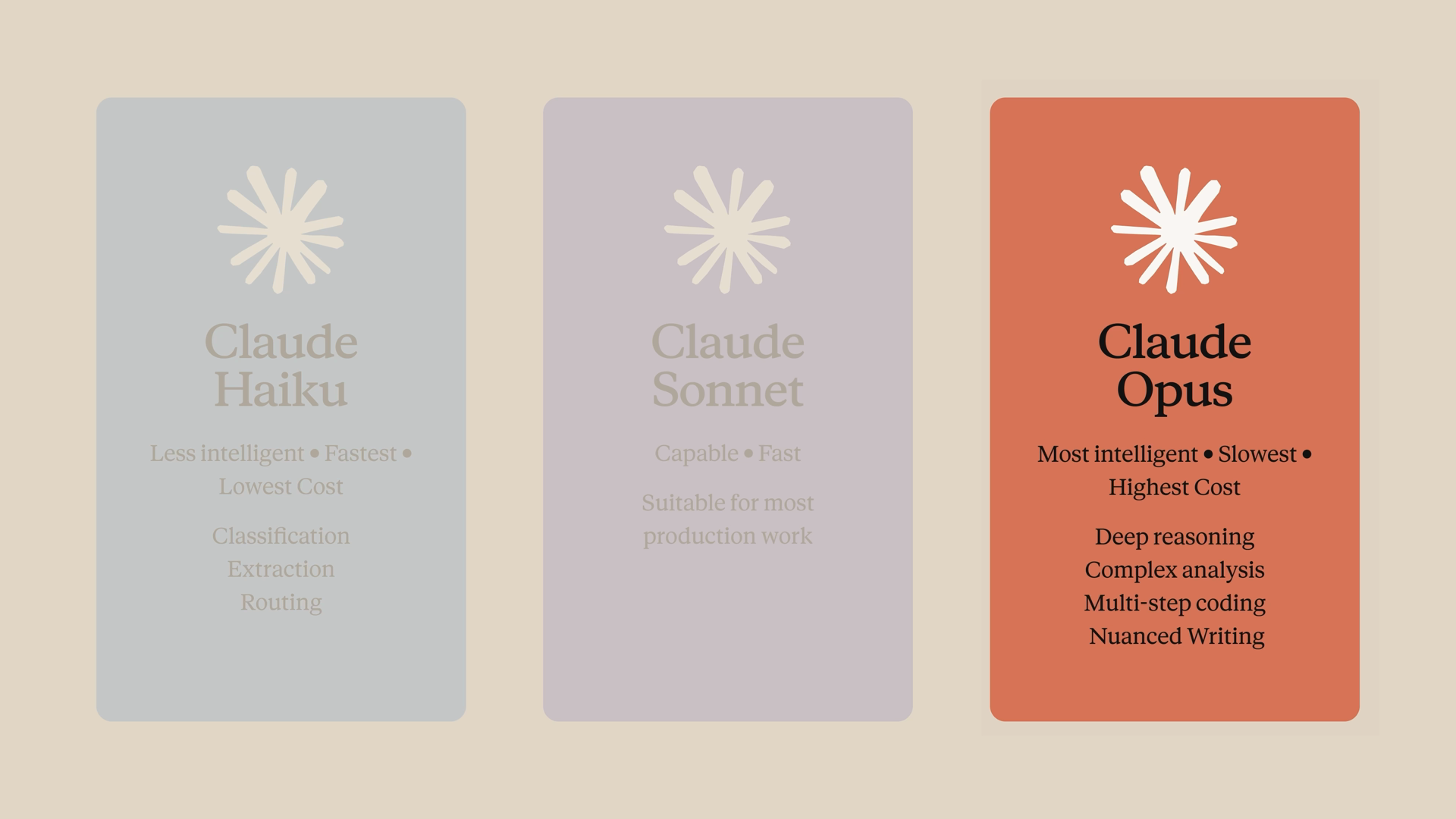
Anthropic currently offers four model tiers, and you choose between them with the model parameter in your API call.
Note that at the time of this course, Claude Fable was not generally available, and are not reflected in the video above. Learn more about Claude Fable and Claude Mythos here.
- Claude Fable is our most capable model yet — a new tier that sits above Opus, built for your toughest challenges. It comes at a significantly higher cost than Opus, so reserve it for work where that extra capability is worth paying for.
- Claude Opus is the most capable of the three core model families, but also the slowest and highest cost of the three. Use it for deep reasoning, complex analysis, multi-step coding, and nuanced writing.
- Claude Haiku is the fastest and lowest cost, optimized for speed and cost efficiency rather than maximum intelligence. Use it for high-volume, low-complexity work like classification, extraction, and routing.
- Claude Sonnet sits in the sweet spot: a balanced combination of intelligence, speed, and cost that works well for most production work.
Start with a simple evaluation
Before you write production code, set up a simple evaluation: a set of example inputs that you run through each model and score against what good output means for your use case. You don't need anything fancy — 20 or 30 representative examples from your actual workload is enough to start.
Then work your way up the tiers:
- Run your examples through Haiku first. If the quality holds, you're done — and you just saved a lot of money.
- If it doesn't, step up to Sonnet.
- Only reach for Opus when the task needs it.
Comparing the tiers side by side
Let's see the difference between the tiers, not just talk about it. We'll send the same prompt through all three models and watch the latency and token counts:
models = ["claude-haiku-4-5", "claude-sonnet-4-6", "claude-opus-4-7"]

for model in models:
    response = client.messages.create(
        model=model,
        max_tokens=300,
        messages=[{"role": "user", "content": prompt}],
    )
    print(model, response.usage)
Two things are going on here:
- The loop swaps the
modelfield on each request. Same prompt, same max tokens — only the model changes. response.usagegives you the input and output tokens straight back from the API, which is what your bill is calculated on.
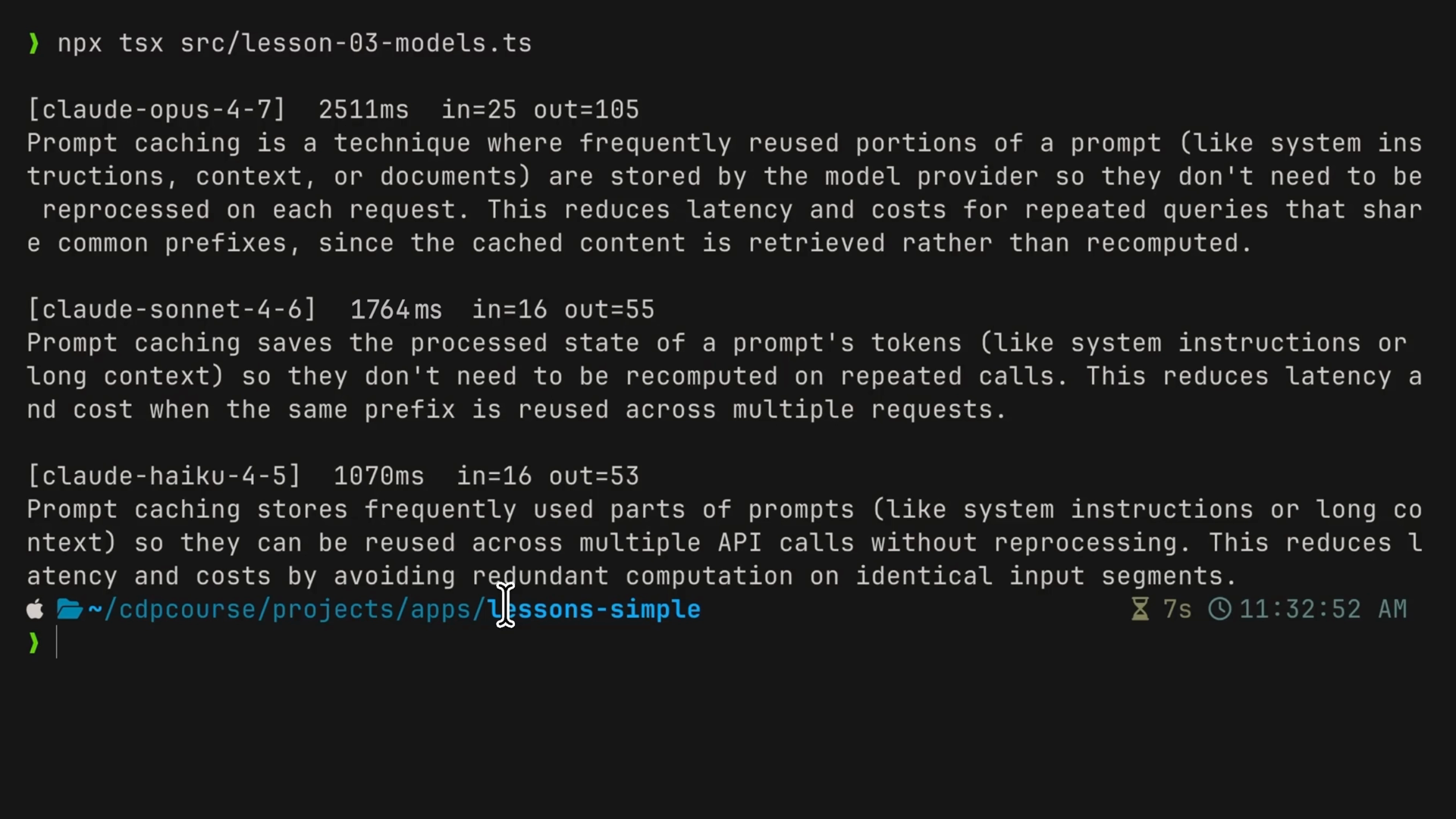
Run it and you'll see three models and three sets of numbers. Opus takes the longest and reads the most polished — but for a two-sentence definition, that polish is wasted. Sonnet tightens the writing up a little. And Haiku comes back, often in under a second, with a very competent two-sentence answer. It's honestly perfect for this kind of scenario.
And that's the whole point: the right model is the cheapest one whose output you'd actually ship. For a definition, Haiku is plenty. For drafting a regulatory response, you'd run the same comparison and probably end up on Opus. The eval is the same shape every single time.
Routing different work to different models
In a real app, you'd route different kinds of work to different models inside the same endpoint. Take an operations dashboard with a document processing route:
- Every incoming file gets classified with Haiku.
- Client updates get drafted with Sonnet.
- Only RFP responses reach for Opus.
One queue, three models, picked per task.
Recap
- Anthropic offers three model tiers: Opus for hard problems, Sonnet for daily work, and Haiku for volume.
- Set up a simple evaluation — 20 or 30 representative examples from your real workload — before writing production code.
- Run the eval from Haiku upward and stop at the cheapest model whose output you'd actually ship.
response.usagereports input and output tokens, which is what your bill is based on.- In production, route different tasks to different models inside the same endpoint instead of picking one model for everything.
🎬 Video transcript
Source video:
UAeTSBsK71A
No transcript available — see lesson body for narrative content.
🔁 Related lessons
- Next: The agent loop explained
- Previous: Your first API call
- Part of paths: Path C
- Reference docs: Glossary · Skills atlas · By use-case
📚 Source & attribution
- Original Anthropic Academy lesson: https://anthropic.skilljar.com/claude-platform-101/486252
- © 2025 Anthropic. Educational fair-use only.